

Gemini 3.1 Pro · no tools
Verdict: SHORT SQUEEZE (bullish reversal)Built on the prompt’s assumption that OI was climbing. Returned a
plausible narrative plus a 100-line Python script for you to run on
your own Crypto Data feed. No live numbers. No chart.
Context · grounded
Verdict: Neutral / MixedBuilt from the live 7-day Crypto Data feed. Open interest was actually
contracting −4.35%. Returns the rendered dashboard, the exact
metrics, and a grounded trade read.
The question
A single, demanding BTC order-flow prompt: aggregate funding and open interest across all exchanges over 7 days at 1h granularity, overlay price, run rolling CVD regressions, classify the regime with the OI matrix, scan for absorption, and deliver one dashboard plus a trade verdict.Read the full prompt
Read the full prompt
A · Gemini 3.1 Pro, no tools
With no access to the live feed, the model accepted the prompt’s framing (“steady OI climb”) and reasoned from there. It produced a confident, well-structured analysis, and then handed back a Python engine for you to run yourself, because it never had the data.Trade-Setup Verdict: SHORT SQUEEZE (Bullish Reversal) With negative funding, rising OI, and bullish downtrend absorption confirmed, the market is primed for a violent short squeeze. […] Who is trapped? New Shorts.Notice what is missing: no real funding value, no real OI delta, no liquidation figure, no rendered chart. The conclusion rests entirely on the assumption that OI was rising.
Gemini's full response (narrative + Python engine)
Gemini's full response (narrative + Python engine)
The model returned a multi-section narrative followed by a complete
In other words: here is the code to build the dashboard once you’ve sourced and
cleaned the Crypto Data yourself. The model can describe the method perfectly. It
cannot fetch the data or produce the chart.
pandas / scipy / matplotlib script (roughly 100 lines) ending with:B · Context, grounded
Context ran the live pipeline against the real Crypto Data feed, computed every metric the prompt asked for, and returned the rendered dashboard plus exact numbers.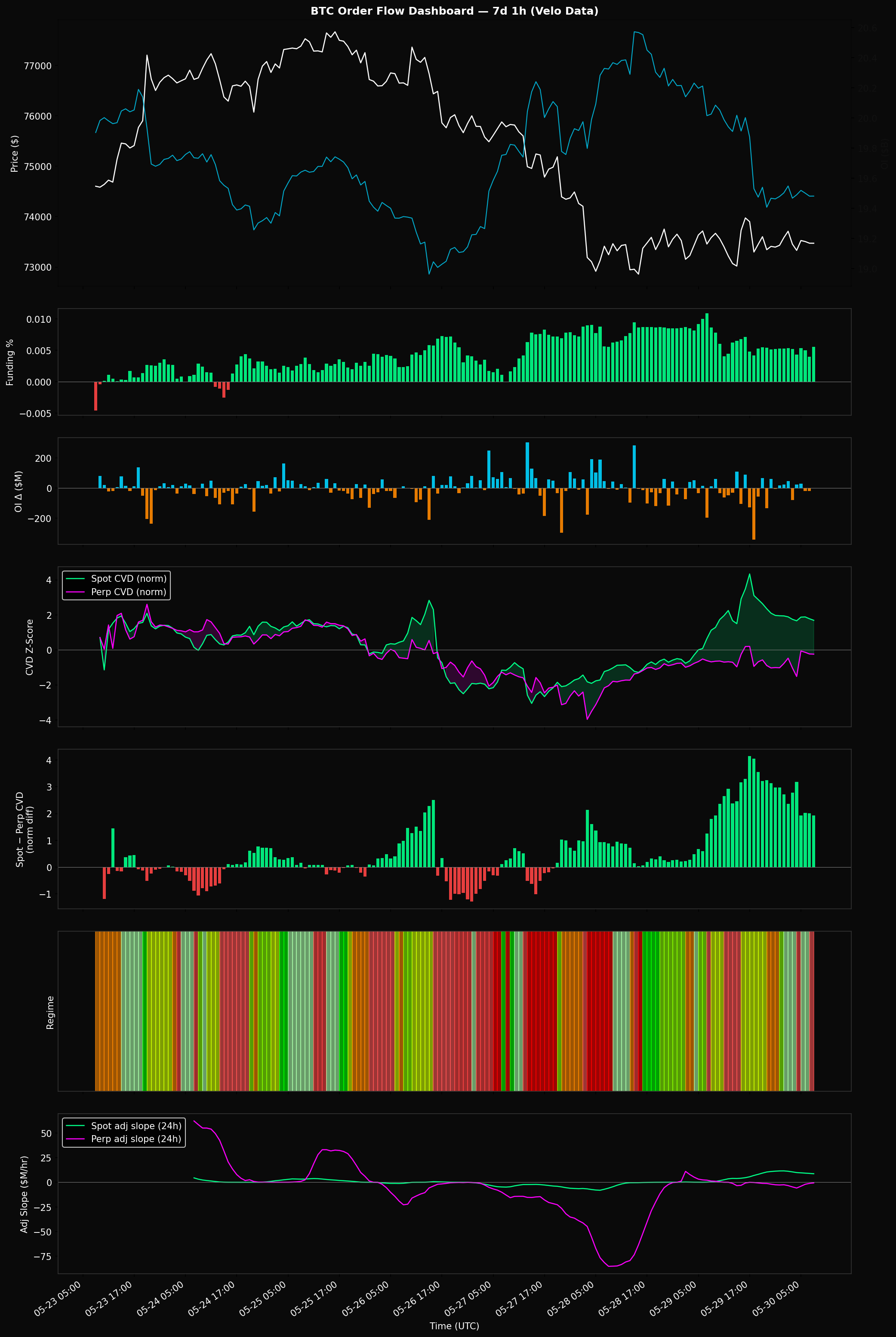
BTC order-flow dashboard: 7-day Crypto Data aggregate, 1h granularity, built from live data.
The real 48-hour metrics
The grounded read
- Regime (OI matrix): flat price + falling OI + below-average volume lands on weak uptrend / short-covering, not the new-money strong uptrend a bullish squeeze would need.
- Absorption: spot CVD trending up (+$8.67M/hr) while perp CVD is flat-to-negative = real spot absorption of perp-driven selling.
- Who’s trapped: earlier shorts are under pressure (−$219M sell-liq imbalance, funding still positive), but mid-week longs are exposed because OI is declining, so no fresh margin confirms the move.
Verdict: Neutral / Mixed: lean cautiously bullish on absorption, but wait for confirmation. Watch for a reclaim of local highs with simultaneous OI expansion and funding dipping toward zero. Until then, this is a wait-and-confirm environment, not a high-conviction entry.
Data: Crypto Data, 7-day 1-hour aggregate across Binance, Bybit, OKX,
Hyperliquid, Deribit (perps) and Binance, Bybit Spot, OKX, Coinbase (spot).
What this shows
Ungrounded models echo your premise
Gemini had no feed, so it trusted the prompt’s “steady OI climb” and built a
bullish squeeze thesis on top of it. The reasoning was clean; the foundation
was assumed.
Grounded answers check the premise
Context pulled the live data, found OI was actually down 4.35%, and the
verdict changed. The data is the deliverable, including the chart you can
act on.
Try it yourself
The grounded answer above came from the same public SDK surface your agent can hit today. Drop in the full prompt from the accordion above:Start with the SDK
Drop the Lite MCP into your agent in one config block.
How the runtime works
See the full architectural story behind the grounded answer above.